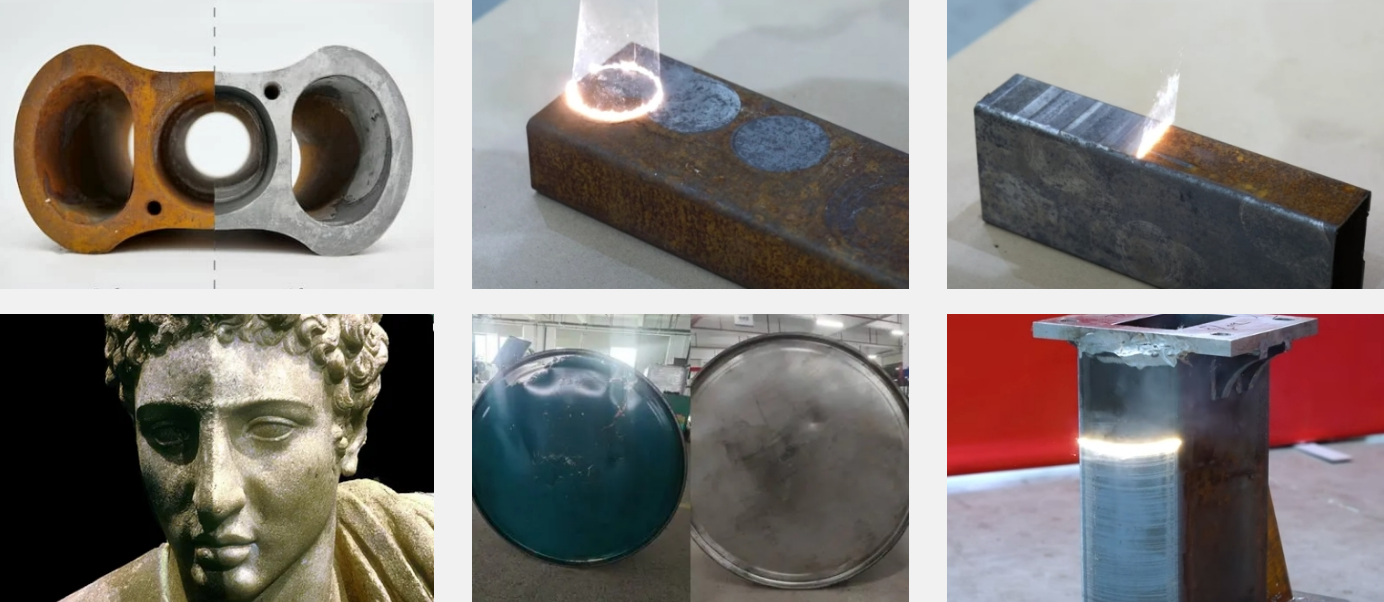
Every welding supervisor deals with grinders screaming through the shift, pickling tanks eating through gloves, and weld seams that still show heat tint no matter how long someone works them over with a flap disc. A laser cleaning machine for metal needs to handle both ends of the job, pre-weld oxide removal and post-weld discoloration cleanup, without dragging your cycle time in the wrong direction.
This guide breaks down Laser cleaning for welding stage by stage, covering rust, oil, and mill scale before the arc strikes, then spatter, slag, and heat tint after. We map out power settings and scan speeds for stainless, aluminum, carbon steel, and titanium. You will also get direct cost and time comparisons against sandblasting and chemical pickling, plus real shop-floor numbers to run your own ROI before you call a supplier.
Pre-Weld Surface Preparation: Removing Rust, Oil, Oxide Scale, and Coatings
ISO 8501-1 Sa 2½ sets the standard for pre-weld cleanliness: no visible oil, grease, mill scale, rust, or old coatings, allowing only faint shadows. Traditional carbon-steel prep reaches that mark through a multi-step grind: degrease with acetone, wipe with lint-free rags, blast or flap-disc the rust and scale, blow off the grit, and re-wipe before the arc strikes. Every step adds labor hours and another chance to recontaminate the joint.
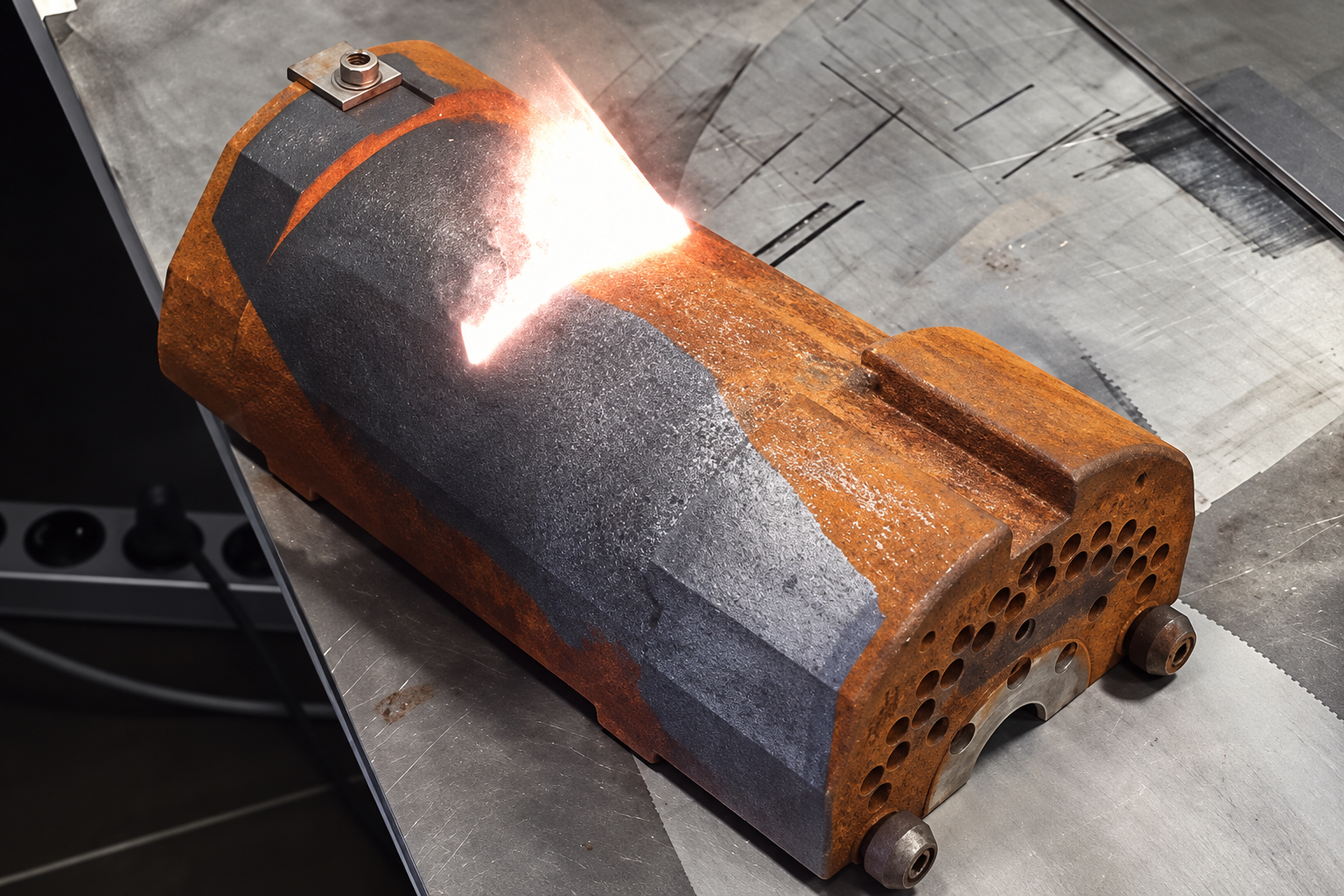
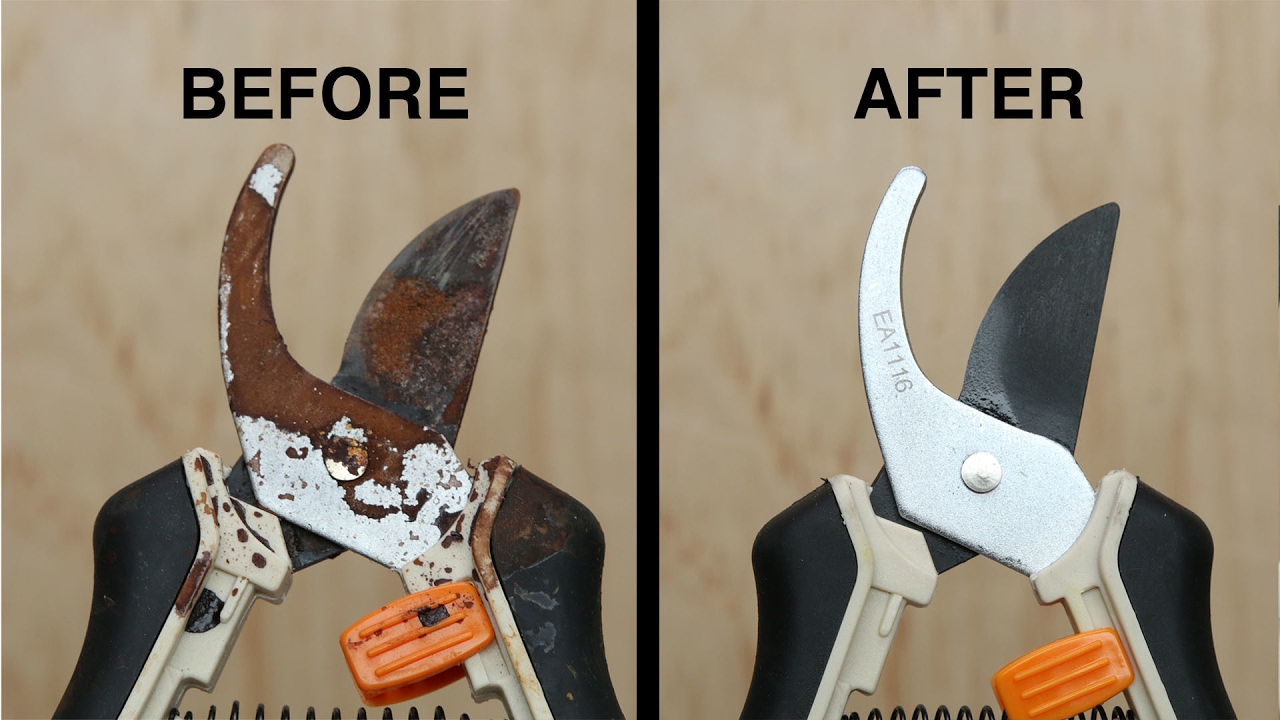
A handheld laser cleaner for welding collapses that sequence into a single pass. A 100W fiber laser system clears light rust and surface oxide at 2 to 4 m²/hour—matching the pace of a 40-60 grit flap disc—without dust, solvent rag disposal, or grinding heat that bakes contaminants into the steel. For heavier mill scale or galvanized stock, a 200W laser cleaning machine strips zinc clean without torch-burning, avoiding the zinc oxide vapor OSHA flags as a metal-fume-fever hazard.
Coatings still need to clear at least 4 inches beyond the weld zone, whether you strip with a laser or abrasive media. The biggest shift comes on aluminum and stainless steel: laser Cleaning aluminum skips iron contamination entirely, since no wire wheels or grit media cross between ferrous and nonferrous parts.
Under the beam, joint prep leaves bright, bare metal right away. The steel stays dry and dust-free, with no solvent residue waiting to flash off before fit-up.
Post-Weld Cleaning: Heat Tint, Weld Spatter, Slag, and Oxide Removal
Heat tint shows up on every stainless weld. That straw-to-blue band along the bead is a thickened oxide layer, and anything darker than pale yellow cuts corrosion resistance right where the metal needs it most. Traditional shop fixes come down to grinding or pickling, and neither option is clean.
A weld seam cleaning laser removes stainless steel weld discoloration in a single pass without an acid bath. A 200W fiber laser clears heat tint and HAZ oxide at 3-6 m²/hour, restoring the surface to bright metal without nitric or hydrofluoric acid. Pickling paste, by comparison, demands brush-on dwell time, a full rinse cycle, and controlled chemical handling before anyone can sign off on the part. Electrolytic cleaning gets close on oxide removal, but it runs slower and leaves a wet surface you still have to dry off.
Spatter, Slag, and Flux Residue
Chipping hammers and needle guns still handle bulk slag from SMAW or FCAW passes. Once that loose material is off, a handheld laser cleaner for welding finishes the job, stripping adherent spatter and flux residue that wire brushing misses. Power brushing tops out around SSPC-SP 3. Laser cleaning pushes past that toward near-white metal without embedding abrasive grit into the stainless surface the way blasting can.
That makes a practical difference for welding joint surface treatment on parts headed straight to inspection or coating. You avoid embedded grit, acid halos, and secondary blasting after local repairs. The weld toes, the adjacent HAZ, and the cap all clear in the same pass.
Stainless Steel, Aluminum, Carbon Steel, and Titanium: Material-Specific Parameters
Four metals, four different reflectivity and thermal profiles, four different laser recipes. Get the physics wrong and you either leave oxide behind or blast straight through a thin section.
Thermal conductivity drives the settings. Aluminum conducts heat about 10 times better than titanium and 10 times better than 304 stainless steel. Because heat dissipates before forming a melt pool, aluminum needs a higher pulse frequency and faster scan speed. Titanium conducts heat at ~6.7 W/m·K and holds it at the surface, so lower power with slower passes keeps the heat-affected zone tight.
Melting range sets your ceiling. Aluminum melts at 582–652°C, far below carbon steel (1,425–1,540°C) or titanium (1,600–1,660°C). A 200W setting that is safe on A36 carbon steel will warp thin aluminum sheet if dwell time runs too long.
Hardness and corrosion behavior matter for weld joint surface treatment, too. Carbon steel A36 corrodes without coating or oil, so cleaned joints need fast weld-out. Titanium Ti-6Al-4V resists seawater and oxidizing environments, holding up through aerospace-grade inspection. 304 stainless handles general corrosion well, though 316 is the call under chloride exposure.
For procurement, specify alloy/grade, temper, thickness, ASTM/AMS standard, mechanical minimums, surface condition, mill cert, and passivation requirements before quoting laser cleaning equipment. Supplier recommendations depend on that spec sheet.
Laser Cleaning Parameters for Welding: Power, Speed, Pulse, and Scan Width
Numbers win arguments with purchasing committees. Here is parameter data pulled from handheld and in-line laser cleaning trials across the four metals that matter most on a weld shop floor.
Power Settings by Scan Width
On a 1200W handheld system, power requirements shift with track width as well as material type. 304 stainless steel holds steady at 15% power (about 180W) whether you run a 5mm or 10mm scan width. Q235 carbon steel needs 15% at 5mm but jumps to 25% at 10mm. 1060 aluminum runs hottest, taking 30% at 5mm and climbing to 40% at 10mm. H62 brass sits between them at 25-30%. Wider tracks cover more ground per pass, but they need more energy density to clean completely. Skip that adjustment, and you leave streaks of unremoved oxide.
Aluminum-Specific Parameters
Aluminum draws the most published test data because reflectivity makes it tricky to dial in. A baseline setting for 6005A aluminum before welding runs 150W, 0.8 m/min, 125 Hz scan frequency, 130 kHz pulse frequency, and a 60mm scan width. Published trials span a wider window, running 25-200W power, 0.5-1.2 m/min speed, and 25-200 Hz scan frequency. For synchronized aluminum-body welding setups, shops commonly pair 200W with 0.5-1.1 m/min and a narrower 45mm line width.
Pulse Duration and Scan Frequency
Thin or sensitive surfaces call for shorter pulses. A pre-weld cleaning run with a Q-switched Nd:YAG laser used 100 ns pulses at 180 Hz, 95 mm/s speed, and a 20mm scan width. That provides a conservative benchmark to start from before raising power. For high-power continuous cleaning on weld beads, reported ranges reach 1,200-3,900W at 1.8-4.5 m/min, with one optimal setup running 3,300W, 3.6 m/min, and 300 Hz oscillation.
Laser Cleaning Versus Grinding, Sandblasting, and Chemical Pickling
Numbers settle this argument faster than opinions do. One shop ran a 4×8 ft plate through laser cleaning in 12 minutes for about $0.30 in electricity and lens wear. The chemical process it replaced cost $18 in chemicals and labor for that same plate. That gap shows up across every method once you compare speed, substrate damage, and cleanup.
Criterion | Laser Cleaning | Grinding | Sandblasting | Chemical Pickling |
|---|---|---|---|---|
Speed | 1–10 m²/h (200–1,000W); 2–6 m²/h on heavy-duty 1,000–3,000W systems | ~2–3 m²/h | 10–30 m²/h; one 300W comparison hit 12 min/m² | 10–50 kg scale/h batch; ~4–6 m²/h including treatment |
Substrate loss | Near zero; 500W pulsed laser held SSPC-SP 10 with original roughness intact | Removes base metal, rounds edges | 25–75 µm substrate loss, roughness up 10–20 µm | Etching risk, requires rinsing and drying |
Surface roughness | Ra 1–2 µm | Directional scratches, needs polishing | Ra 12–18 µm | Ra 8–10 µm |
Waste | Fine particulate only | Metal dust, worn discs | Spent grit, airborne particulate | Acidic wastewater, sludge |
Operating cost | ~$0.30/plate | Low equipment, labor-heavy | $120–200/h outsourced; ~$25/h media | $0.40 L toxic waste/m² reported |
Grinding still makes sense for heavy, localized burrs where dimensional tolerance does not matter. Sandblasting stays the fastest choice for large, rough structures that need a high-profile surface for coatings. Chemical pickling only works if you already have immersion tanks and wastewater treatment on site.
When you weigh laser cleaning against sandblasting before welding, laser preserves the substrate and leaves zero embedded grit, but sandblasting clears massive flat areas much faster.
Pipeline and Stainless-Steel Fabrication: Pre- and Post-Weld Case Workflow
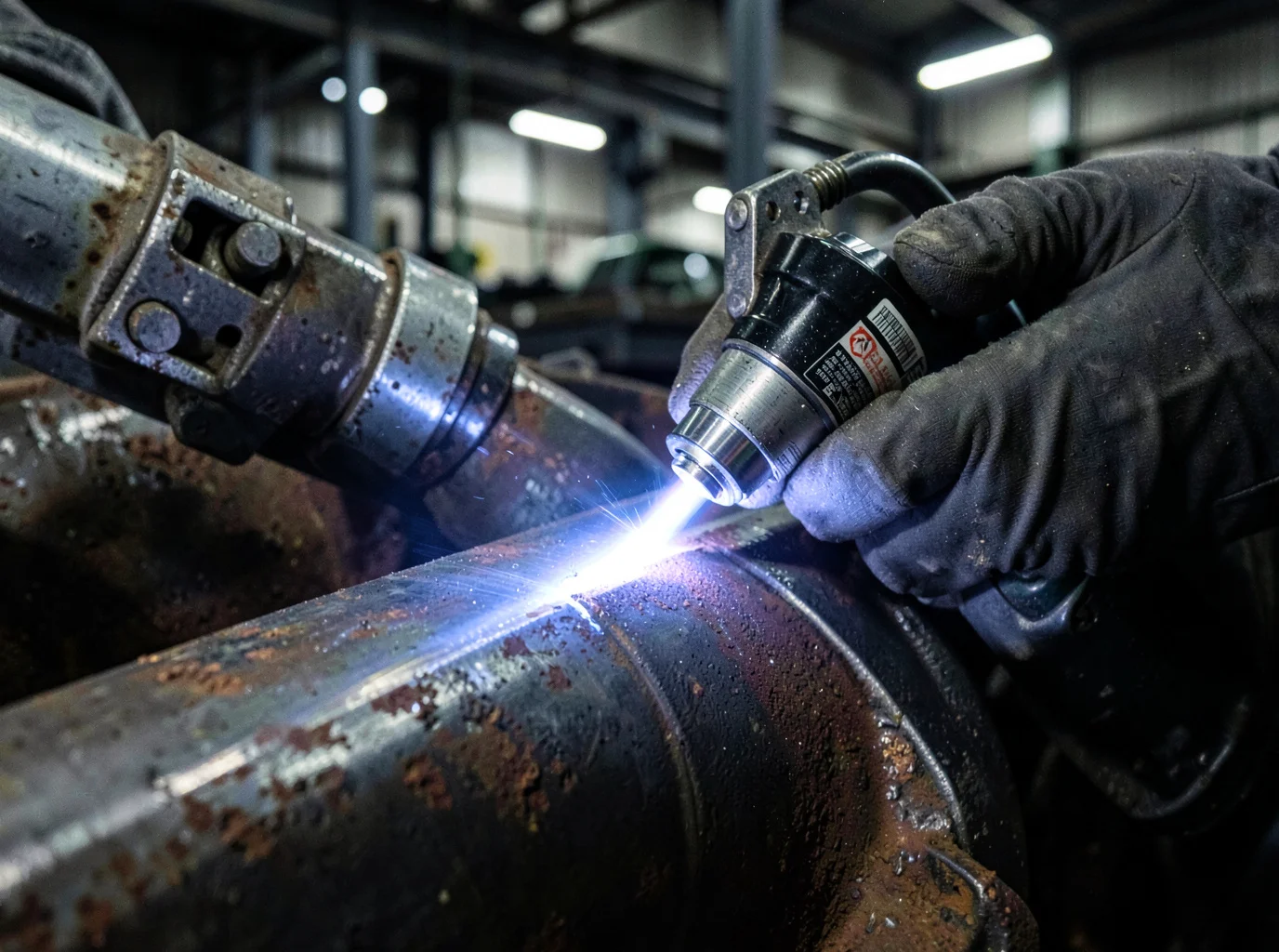
A pipeline spool doesn't move to the welder until the paperwork clears. The shop approves the WPS and PQR, checks welder qualifications against material group, diameter, and position, and builds an Inspection and Test Plan to track fit-up, preheat, root-pass inspection, and final release. Laser cleaning fits directly into that chain at two checkpoints.
Before fit-up, the ITP requires the weld zone to be clear of oil, grease, paint, zinc, moisture, and crayon marks. A handheld laser cleaner for welding handles that prep without cross-contaminating stainless-only tools from the carbon-steel bay next door. Inspectors still verify bevel angle, root face, root opening, and alignment against the WPS, but oxide layer removal before welding no longer needs a grinding step that risks embedding iron into 304 or 316 stock.
After welding, heat tint control is a documented requirement. Heavy oxidation cuts corrosion resistance, so fabrication specs mandate its removal before pickling and passivation under ASTM A380/A380M. One industry process still runs 20-50% nitric acid at 20-50°C for 20-30 minutes to restore the surface. A weld seam cleaning laser brings the joint to bright metal before that chemical bath starts, cutting acid exposure time and tank load on the shop floor.
Automotive Components: Aluminum and Carbon-Steel Weld Cleaning
Aluminum oxide doesn't wait around. Strip it off a body panel, battery tray, or die-cast housing, and the metal starts rebuilding that layer within minutes. Welding standards give you 4 hours maximum between cleaning and welding; miss that window, and you have to clean it again.
Aluminum prep starts with a degreasing pass using acetone or an approved solvent. Breaking the oxide layer requires a dedicated stainless-steel brush that has never touched carbon steel, or embedded steel particles will cause corrosion later. Run 100% argon shielding gas at 15-25 CFH, paired with ER4043 or ER5356 filler.
Carbon-steel parts like chassis rails, brackets, and exhaust components take a different route. Strip off rust, mill scale, old paint, and seam sealer with abrasive discs, wire brushes, or a laser cleaner before striking an arc.
For laser setups, 100-300W pulsed systems clean thin aluminum and light discoloration without heat distortion. Continuous 1,000-1,500W systems clear heavier oxidation and weld burns on structural steel parts. Keep separate workstations for each metal—steel grit on aluminum compromises weld integrity every time.
Purchasing and ROI Calculation for a Laser Cleaning Machine for Metal
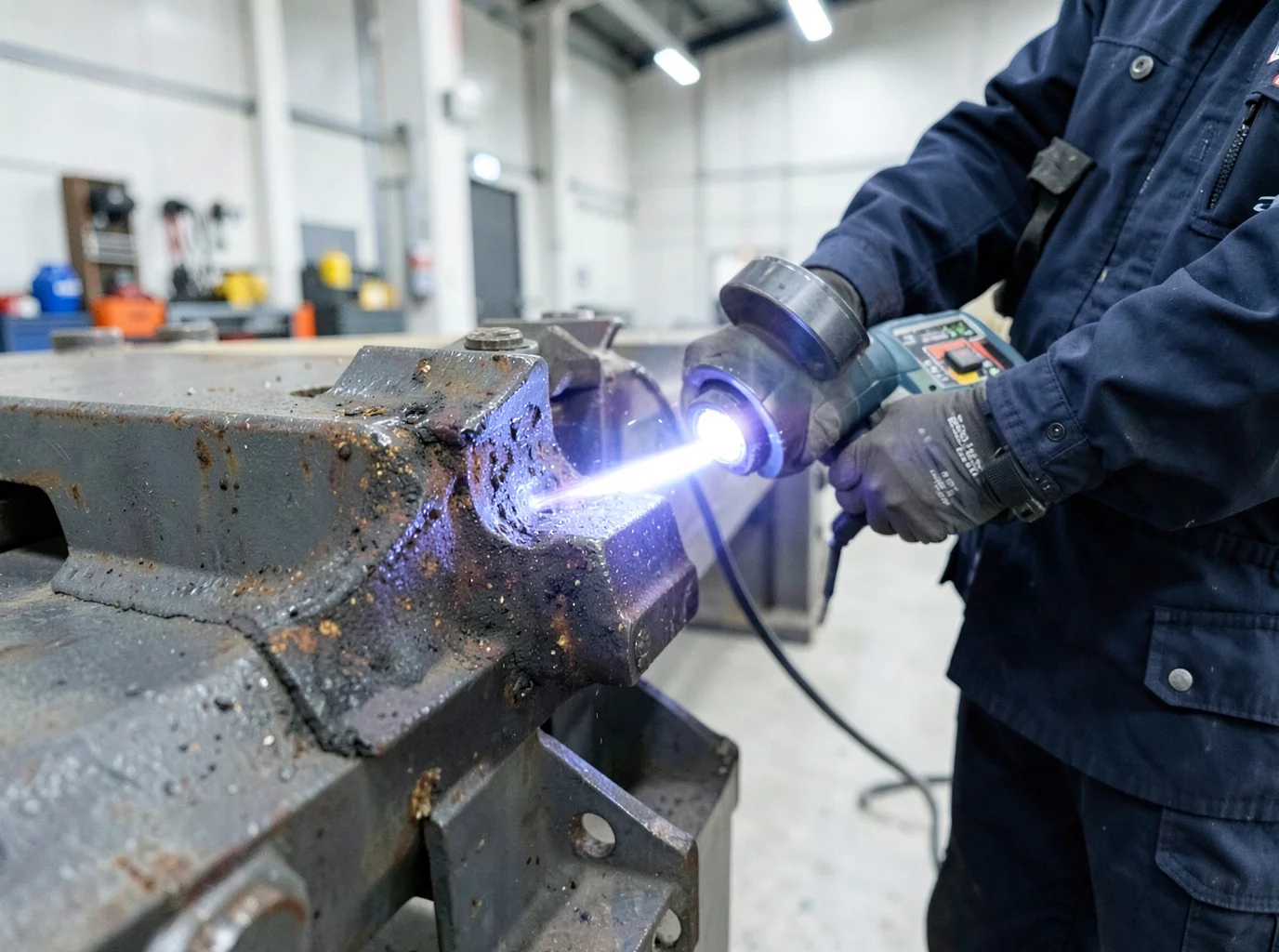
Price tags vary by a factor of 20 depending on power and application. A 100-300W pulsed fiber system for precision oxide, paint, and weld-prep work runs $5,000-$25,000. Production-grade 100-200W pulsed machines built for recurring weld prep require a budget of $20,000-$35,000. For structural steel and heavy mill scale, high-throughput 1,000-3,000W CW systems cost between $3,500 and $13,000, while 1,000-2,000W pulsed setups with automation and cooling reach $27,500-$90,350. Skip anything under $2,000, as those listings routinely omit extraction, safety enclosures, and commissioning.
Running Costs and Payback
A 100-200W CW unit draws around 1.5kW. Running it 4,500 hours a year consumes 6,750 kWh, which totals $675-$1,013 annually depending on local power rates. Lens consumables add $1.50-$7.50 per hour, and routine maintenance runs $500-$2,000 a year.
In a sample case with a $33,000 installed cost, displaced labor saves $30,000, while eliminated abrasives and chemicals save another $10,000. Offsetting those gains against $11,000 in operating expenses leaves $29,000 a year in net savings. That yields a 1.14-year payback and a two-year ROI of 75.8%.
Before buying, request a sample test on your actual metal and rust grade, and insist on measured m²/hour rather than wattage ratings alone.
Production Validation, Safety, and Process Traceability Before Deployment
A single clean weld sample proves nothing to a quality auditor. Before a laser cleaning machine for metal earns a permanent spot on the floor, it has to pass three validation stages: process design using your scale-up data, process qualification showing equipment and operators reproduce conforming output, and continued process verification to catch drift after launch.
Build a validation package that includes:
- Approved work instructions, power settings, and acceptance criteria
- A risk assessment linking surface cleanliness (your critical quality attribute) to laser power and scan speed (your critical process parameters)
- Installation, operational, and performance qualification records
- A documented sampling plan with statistical rationale
Safety release gates require verified interlocks, emergency stops, fume extraction interlocks, and closed corrective actions on every safety deviation before sign-off.
Traceability ties each cleaned part to its batch ID, operator, equipment serial number, laser parameters, and inspection result. This satisfies ISO 9001 documentation requirements and gives you a defensible audit trail from raw material to shipped weldment.
Conclusion
The math here is straightforward. Swapping grinding and sandblasting for a 200W Laser cleaning machine for metal cuts pre-weld prep time by 60 to 70%, while post-weld oxide layer removal that once took a technician 15 minutes per joint now runs in under three. Stainless steel shops eliminate the heat-tint rework that chemical pickling never quite solves, and aluminum fabricators stop fighting oxide re-formation between cleaning and welding. That changes the cost structure for every linear foot of weld seam your shop produces.
If your welding floor is still burning labor hours on manual prep, check whether your current throughput justifies the equipment cost. For most mid-to-high-volume shops, it does within a year. Pull your monthly prep hours, run them against the parameters in this guide, and request a live demo on your actual material before you sign anything.