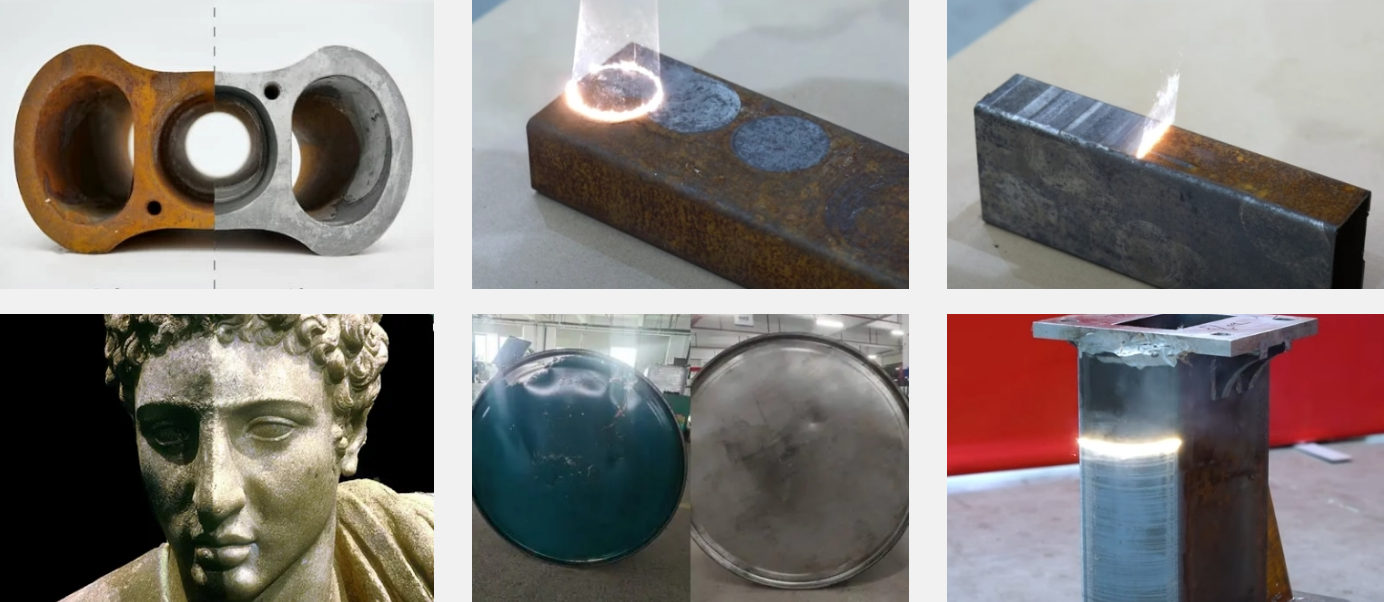
Yes. Laser cleaning can remove mill scale from steel, including the dark, tightly bonded oxide layer commonly found on hot-rolled steel plates, pipes, and structural components.
However, mill scale is often harder to remove than ordinary surface rust. Its strong adhesion and varying thickness can require more laser energy, multiple passes, or a different cleaning system.
For most buyers, the important question is not simply whether laser cleaning works. It is whether the machine can remove the mill scale completely, at an acceptable speed, without damaging the underlying steel.
A laser cleaning machine can be a practical solution for localized steel preparation, weld areas, precision components, and selected industrial descaling applications.
For heavy scale across large steel structures, a higher-power system may be needed to achieve commercially practical throughput.
Mill Scale Condition | Laser Cleaning Suitability | Starting Direction |
|---|---|---|
Thin or patchy mill scale | Good candidate | Pulsed laser cleaning |
Tightly bonded scale on steel parts | Suitable with process testing | Pulsed or higher-output system |
Heavy scale over large steel surfaces | Feasible, but throughput matters | High-power CW |
Very thick or layered buildup | May require multiple processes | Laser and mechanical removal |
The right choice depends on scale thickness, adhesion, steel condition, cleaning area, and the surface finish required after cleaning.
1. Why Is Mill Scale Harder to Remove Than Rust?
Mill scale is a dense oxide layer formed on steel during hot rolling and other high-temperature manufacturing processes.
It commonly contains iron oxides such as wüstite, magnetite, and hematite.
Unlike loose red rust that develops during atmospheric corrosion, mill scale can form a compact layer strongly attached to the underlying steel.
This is why removing it can require more processing than removing light surface rust.
Mill Scale vs Rust
Both are iron oxides, but they form under different conditions and can behave differently during cleaning.
Factor | Mill Scale | Ordinary Rust |
|---|---|---|
Formation | High-temperature steel processing | Exposure to moisture and oxygen |
Appearance | Dark gray or blue-black | Brown, orange, or reddish |
Adhesion | Often tightly bonded | Often more porous or loosely attached |
Removal Difficulty | Can require repeated treatment | Light rust is often easier to remove |
Mill scale may also crack, flake, or become partially covered by rust during storage.
This creates an uneven surface containing both tightly bonded oxide and loose corrosion products.
A laser cleaner must therefore handle the actual condition of the steel rather than treating every dark surface as ordinary rust.
How Laser Cleaning Removes Mill Scale
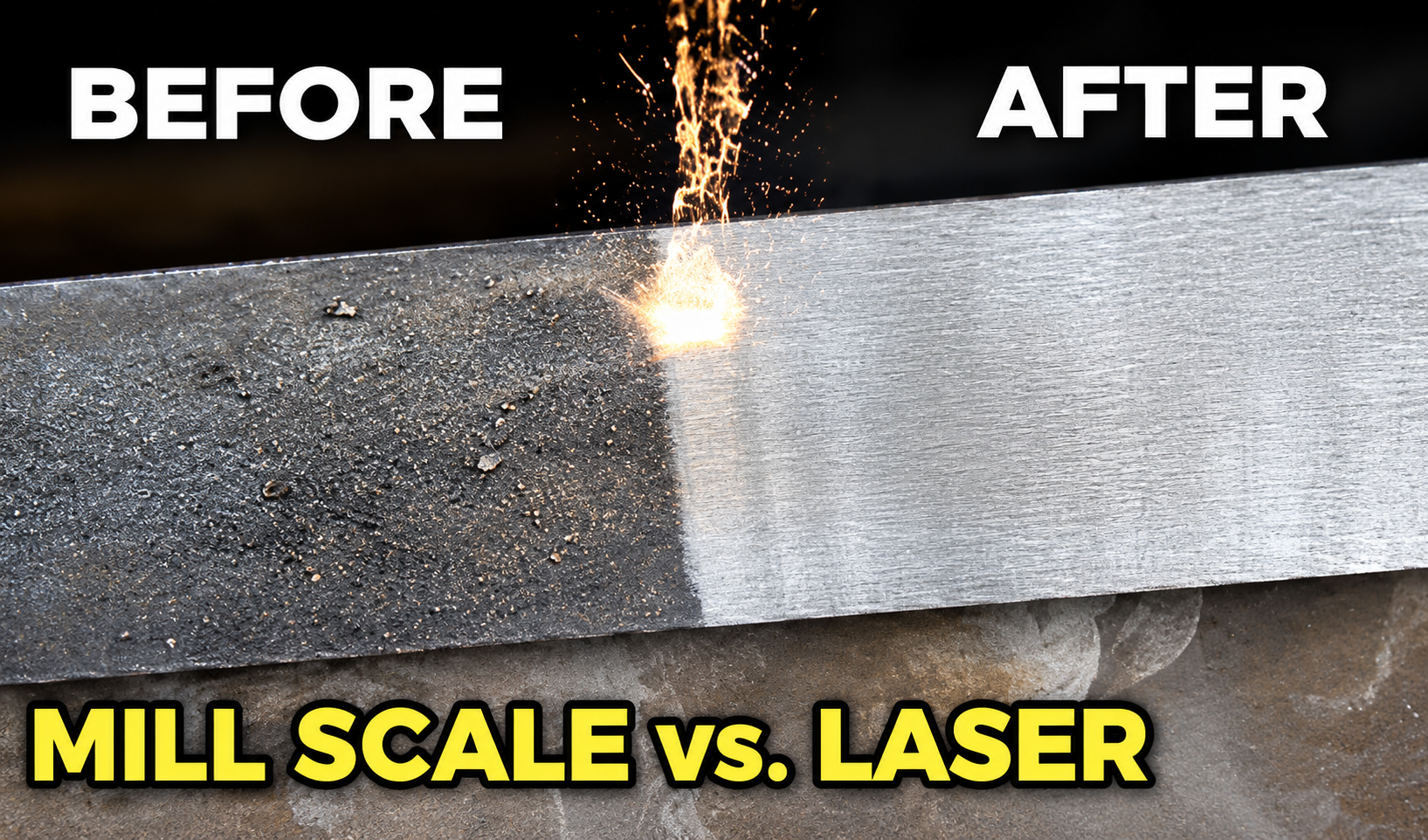
Laser cleaning delivers concentrated energy to the oxide layer.
Depending on the laser source and process conditions, removal can involve rapid heating, ablation, and thermal stresses that weaken the bond between the oxide and steel.
The oxide may break apart, separate from the surface, or be removed through repeated laser passes.
Research on hot-rolled steel has demonstrated that combining different laser-treatment stages can improve the removal of stubborn oxide layers.
However, the removal result depends on the equipment and tested material. There is no universal energy-density threshold that guarantees complete mill scale removal without affecting the substrate.
Too little energy may leave oxide behind.
Excessive energy or slow scanning may heat, discolor, or alter the steel surface.
The objective is to remove the oxide while maintaining the surface condition required for the next manufacturing step.
2. Which Laser Cleaner Is Best for Removing Mill Scale?
The appropriate machine depends mainly on the amount of scale, the size of the workpiece, and how quickly the job needs to be completed.
Both pulsed and continuous-wave laser cleaning systems can remove suitable oxide layers, but they are generally selected for different priorities.
Pulsed Laser Cleaner: Localized and Controlled Removal
A pulsed laser cleaner delivers energy through short laser pulses.
This can provide greater control when removing thin or localized oxide layers from steel components.
Typical applications include weld preparation, machinery parts, precision components, and selective cleaning where the surrounding surface should remain largely unchanged.
A pulsed system may be particularly useful when dimensional accuracy or surface condition matters more than maximum area coverage.
LaserCleanerPro offers pulsed configurations in the 100–500W class for oxide removal, rust cleaning, and precision industrial applications.
However, a lower-power pulsed cleaner may require more passes when mill scale is thick and strongly bonded.
For a small component, that may be acceptable.
For hundreds of square meters of steel plate, the additional processing time could become a major cost.
CW Laser Cleaner: Heavy Scale and Large Steel Surfaces
Continuous-wave laser cleaning provides sustained energy output and is often selected for larger, more heavily contaminated steel surfaces.
A high-power industrial laser cleaner can be a better starting point when the main objective is removing significant mill scale from robust steel structures at production speed.
Typical applications include structural steel, large machinery, steel plates, fabricated beams, and heavy industrial components.
LaserCleanerPro's high-power CW range includes 1000–3000W systems designed for heavy rust, mill scale, and large-area cleaning.
The advantage is throughput potential.
However, higher power also requires careful control of scanning speed, heat input, and surface condition.
More wattage does not automatically mean better cleaning quality.
For a thin precision component, controlled pulsed cleaning may be more appropriate than using a high-power CW system.
Does Thick Mill Scale Require Multiple Passes?
Often, yes.
A thin oxide layer may be removed relatively quickly, while a thick or tightly bonded layer can require repeated scanning.
The number of passes depends on the actual scale rather than a fixed thickness-to-power formula.
For particularly heavy buildup, mechanical removal of the bulk material followed by laser finishing may be more efficient than relying on laser cleaning alone.
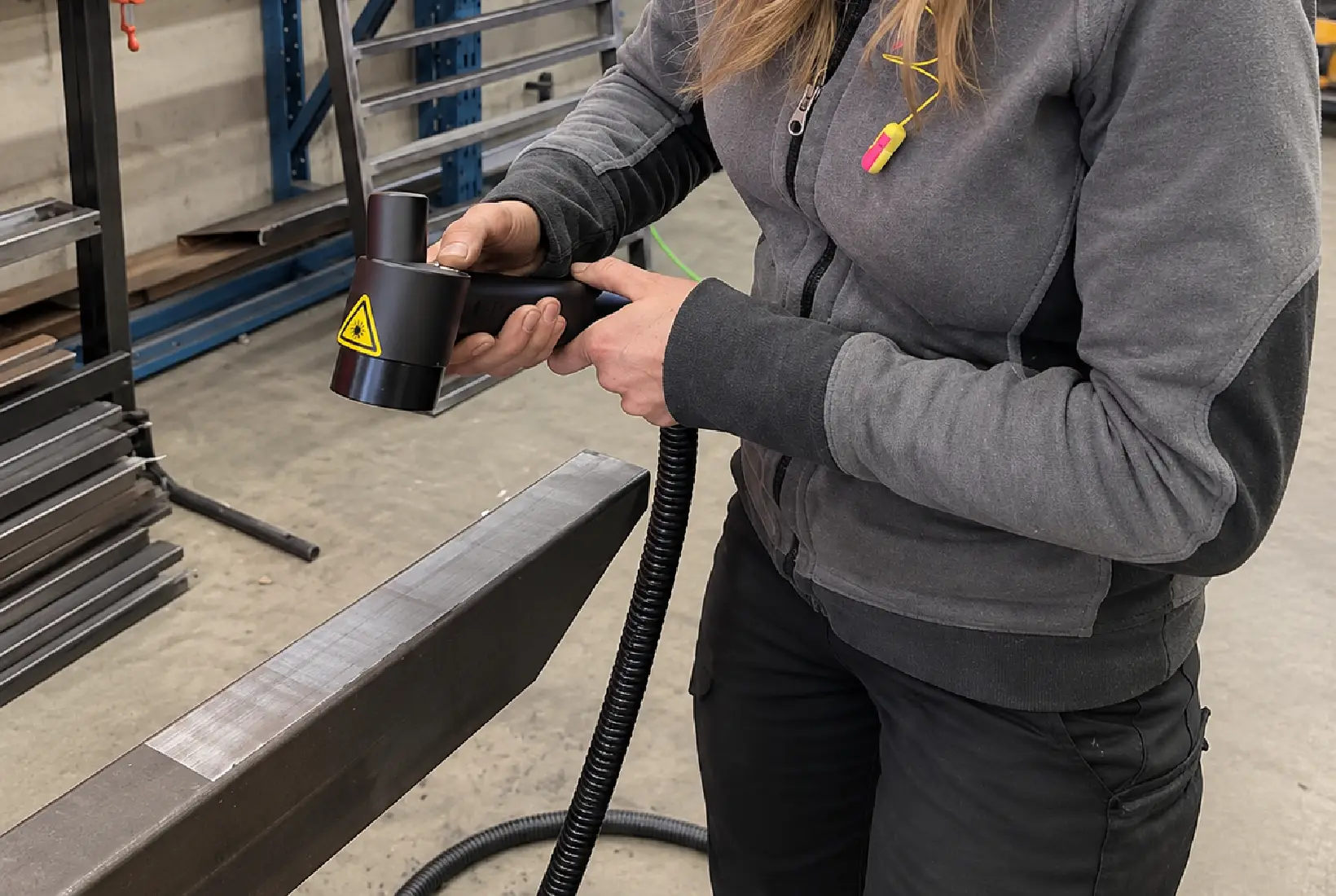
Before selecting a machine, ask the supplier to test steel with the same scale condition you expect to encounter in production.
3. How Do You Check Cleaning Speed and Surface Quality?
For industrial buyers, successful mill scale removal is not just about making steel look brighter.
The cleaned surface must meet the requirements of the next process, whether that is welding, painting, coating, or another manufacturing operation.
Test the Actual Mill Scale
A representative sample test is the most reliable way to evaluate equipment.
Use steel that matches your normal production material, including the oxide condition, surface geometry, and degree of adhesion.
During the test, record:
Steel grade and mill scale condition
Laser type and power configuration
Cleaning width and number of passes
Total cleaning time
Final surface condition
If the scale varies significantly across the part, test more than one representative area.
This helps determine whether the process is stable enough for real production rather than only for a demonstration sample.
Measure Real Cleaning Speed
Do not rely only on a supplier's advertised maximum m²/h figure.
A cleaning rate measured on thin surface rust cannot be directly applied to thick mill scale.
The useful measurement is:
Actual Cleaning Rate = Acceptably Cleaned Area ÷ Total Cleaning Time
For routine production planning, include the time required for repeated passes and normal handling.
A machine that removes all visible scale in one slow pass may not necessarily be more productive than one that completes the same work in several faster passes.
What matters is the final acceptable result and the total time needed to achieve it.
Check the Required Surface Finish
The required condition depends on what happens after cleaning.
For welding, the joint area must meet the cleanliness requirements of the welding procedure.
For painting or protective coatings, removing mill scale is only one part of surface preparation.
The coating system may also require a specified surface profile, controlled dust levels, and limits on soluble contamination.
Laser cleaning does not automatically create the same surface roughness as abrasive blasting.
Standards such as ISO 8501-1 and SSPC-SP 10 describe blast-cleaning grades. A laser-cleaned surface should not be declared compliant with those requirements solely because it looks similarly clean.
For coating-critical projects, confirm whether the laser-treated surface meets the project specification through appropriate inspection and testing.
Include Safety and Fume Extraction
Laser cleaning does not consume abrasive grit, but the removed oxide does not simply disappear.
The process can generate airborne particles and fumes that need suitable extraction.
Industrial laser cleaning systems may also present Class 4 laser hazards, including risks from reflected beams.
Use the required engineering controls, extraction equipment, operator training, and protective measures.
A clean result is only useful when the process can be operated safely and consistently.

4. When Is Laser Better Than Sandblasting or Pickling?
Laser cleaning is not automatically the most economical process for every mill scale removal job.
Its strongest advantages are selective treatment, reduced abrasive-media use, and the ability to clean specific areas without immersing or blasting the entire component.
Laser Cleaning vs Sandblasting
Sandblasting remains a practical method for removing mill scale from large steel surfaces.
It can cover broad areas efficiently and produce a surface profile suitable for protective coating systems.
Laser cleaning becomes attractive when the work is localized, the steel component is difficult to move, or abrasive contamination is undesirable.
For example, a fabrication shop may need to remove mill scale only around weld zones rather than across an entire steel plate.
In that situation, a laser rust removal machine can offer a more targeted process.
However, if a large structure requires extensive scale removal and a defined abrasive-blast surface profile, blasting may remain the more productive option.
Laser Cleaning vs Acid Pickling
Acid pickling removes steel oxides through chemical treatment.
It is particularly relevant in industrial operations processing large quantities of steel through established chemical treatment lines.
Laser cleaning avoids the need to immerse parts in acid and does not create spent pickling liquor during the cleaning process.
This can be useful for localized treatment, maintenance work, and parts that are difficult to process through a chemical line.
However, pickling may remain more practical for certain high-volume applications where the necessary chemical-processing infrastructure already exists.
Which Method Is More Cost-Effective?
Compare the total cost of achieving the required surface condition.
Main Requirement | Method Worth Comparing First |
|---|---|
Localized mill scale removal | Laser cleaning |
Large-area cleaning with specified blast profile | Sandblasting |
High-volume chemical descaling line | Acid pickling |
Heavy buildup requiring staged removal | Mechanical cleaning plus laser |
Precision parts requiring controlled surface treatment | Pulsed laser cleaning |
Machine purchase price is only one part of the calculation.
Labor, cleaning time, abrasive or chemical consumption, waste management, safety controls, maintenance, and the cost of rework all affect the final result.
For a business cleaning similar steel components every day, equipment ownership may make sense when actual production savings justify the investment.
For occasional large-scale projects, outsourcing or using an existing blasting process may be more economical.
The most cost-effective method is the one that consistently achieves the required finish at the lowest acceptable total cost.
Conclusion
Can laser cleaning remove mill scale from steel?
Yes. Laser cleaning can remove mill scale from hot-rolled steel, including strongly bonded oxide layers, when the equipment and process are properly matched to the application.
The difficulty depends on scale thickness, adhesion, cleaning area, and the required surface condition.
For thin or localized oxide, a pulsed laser cleaner may provide suitable control.
For heavy mill scale over larger steel surfaces, a high-power CW system may offer better production throughput.
Very thick buildup may still require repeated treatment or a combination of mechanical and laser cleaning.
Before purchasing equipment, do not rely on fixed cleaning-speed claims or universal laser settings.
Test the actual steel, measure the time required for complete removal, and verify that the resulting surface meets the next process requirements.
If you are looking for a laser cleaner for metal to remove mill scale from steel plates, fabricated components, pipes, or structural steel, send LaserCleanerPro your steel grade, mill scale condition, cleaning area, and required finish.
Our team can help compare pulsed and CW configurations and arrange sample testing to evaluate removal quality, cleaning time, and practical equipment requirements before you choose a machine.